
Weekly Real
Estate Archive
Format For Printing
Airlines
Food
Gaming
Healthcare
Networking
Oil & Gas
Paper
Real Estate
Retail
The Real Estate Update
By Michael Dowd (TMF Yorick)
June 26, 1997
The Best Little Poor-House in Texas
(Corporate Kleptomania, or Some Habits Are Hard To Break)
By Jerome E. Scott (MF Foitdog)
With Michael Dowd (TMF Yorick) and William G. Campbell (WGCAMP)
There’s a courthouse about 20 miles south of San Francisco in Redwood City, California. This Friday platoons of highly paid lawyers will descend on it to appear before a 70-odd-year-old California state court judge with a handsome handlebar mustache. What the Honorable Thomas M. Jenkins ultimately decides can dramatically affect the investors in AMERICAN REALTY TRUST <% if gsSubBrand = "aolsnapshot" then Response.Write("(NYSE: ARB)") else Response.Write("(NYSE: ARB)") end if %> which has recently been a very hot stock indeed. It can also affect the investors in three other REITs, but the suit is actually about an American Exchange traded limited partnership, NATIONAL REALTY <% if gsSubBrand = "aolsnapshot" then Response.Write("(AMEX: NLP)") else Response.Write("(AMEX: NLP)") end if %>.
American Realty rocketed from $6.50 on January 1, 1997, to $16.75 by the close of business the last day in March. That 157% increase in 90 days pretty much qualifies the stock for the Real Estate Investment Trust Hall of Fame but it did not appear on our recommended list or that of any of the REITanalysts we know. It has settled a bit from its high of $22 1/4 in April, but at Friday’s close of $11.875, it was still up 83% year to date.
American Realty has clearly taken a spectacular journey but, as some exploration through its 10Ks, 10Qs, and 13Ds will show, that one real estate investment trust is only a piece of the story. As recently as January 1, 1992, American Realty's entire public market capitalization had been a tiny $16 million. Today the formerly tiny company is at the center of a tangled mass of real estate assets its sponsors value at over $2.2 billion. To give you an idea how big that is, you could roll all those assets into a ball and it would become the sixth largest REIT in America.
Unfortunately, when the litigation over American Realty's sister partner National Realty ends in Judge Jenkins’ court, the conclusion may well be dismal for the original investors whose hundreds of millions in hard-earned savings made all these assets possible in the first place. Most troubling, it looks as if the story may involve a court-blessed transfer of well over $200 million in value from the helpless hands National Realty's public Limited Partners to the pockets of the General Partners and their affiliates. All this, despite the fact that all the parties had previously signed off on a 115 page settlement known to the Judge's court as the "Moorman Agreement."
The trail leading up through the arches over the Redwood courthouse steps started in the late 1960s in Gaffney, South Carolina. By 1973, at age 36, Gene Phillips filed a $30 million bankruptcy -- the largest real estate Chapter 11 in recorded South Carolina history. By 1980, Phillips had recovered, taken over the company of a former creditor, and met a talented and resourceful deal-lawyer/wheeler-dealer named William Friedman. The two found a weakness in the financial structure of an Atlanta-based REIT. Manipulating a forgotten pool of outstanding warrants, they took control of a former affiliate of Citizens & Southern Bank, now known as Southmark. As time went on Phillips’s companies bought a company Lear Jet which was later replaced with a DC-9, and generally they flew about as high over Texas as a financier can.
The next collapse was even more spectacular. Southmark bought San Jacinto Savings & Loan, which the regulators finally took over. Drexel Burnham ponied up with $915 million in two tranches of last-ditch financing. With that money, Phillips’s Southmark Corporation made investments that reportedly scared even Michael Milken. Finally, in 1987 Southmark wrote off over $1 billion in one month and the centerpiece to a $9 billion pile of assets headed into another bankruptcy court.
Before that collapse, Southmark had taken over control of a number of partnerships originally syndicated by Robert McNeill, and in 1987 the principals of the wounded Southmark succeeded in rolling up four of those partnerships. They ultimately contributed most of the assets of the newly formed, AMEX-traded National Realty.
The tale then leads to an eight-year court battle in Judge Jenkin’s court with allegations of huge fees and conflicts of interest being hurled by investors’ counsel, and rejected by those representing Phillips and his associated entities. The story involves three other publicly traded REITs controlled by Phillips’ associates, as well. The other REITs are CONTINENTAL MTG. & EQUITY TRUST <% if gsSubBrand = "aolsnapshot" then Response.Write("(Nasdaq: CMETS)") else Response.Write("(Nasdaq: CMETS)") end if %>, TRANSCONTINENTAL REALTY INVESTORS <% if gsSubBrand = "aolsnapshot" then Response.Write("(NYSE: TCI)") else Response.Write("(NYSE: TCI)") end if %>, and INCOME OPPORTUNITY TRUST <% if gsSubBrand = "aolsnapshot" then Response.Write("(AMEX: IOT)") else Response.Write("(AMEX: IOT)") end if %>. All these stocks have elements of common ownership and control with other Phillips entities. Interestingly, all have also been pretty hot performers in the first quarter of 1997, though none tied American Realty.
- NATIONAL REALTY LP UNITS ($100 MM in Market Cap) + 33%
- CONTINENTAL MTG. & EQUITY TRUST (CMETS) -($66 MM) + 30%
- TRANSCONTINENTAL REALTY INVESTORS (TCI) -($49 MM) + 14%
- INCOME OPPORTUNITY (IOT) - ($22 MM ) + 36%
- AMERICAN REALTY TRUST (ARB) - ($196 MM) + $157%
As you will see, we couldn’t honestly tell you if the shares of National Realty will be $6 or $60 or somewhere in between by December of this year. Too much depends on the judge, and perhaps on other potential litigation or even other government intervention. As we will discuss here, the stocks are intimately interrelated, so if anything major does happen to National Realty the waves will certainly rock the other boats as well. As Bette Davis said, "Hold on to your hats, it’s going to be a bumpy ride."
The story came to our attention through two sources at about the same time. First, we monitor stock performance of all REITs and pay particular attention to the small caps where there is little other following. Supply and demand in the small-cap sector of our universe (60 out of 181 <= $200 million), is turf many institutional investors tend to ignore, and it’s one where we snoop around quite a bit.
Then the editor of the Motley Fool's "Daily Double" contacted our TMF Yorick (who hosts the Fool Real Estate board) in mid-February. He inquired if we had any knowledge of why the stock was moving up so briskly. American Realty had more than doubled year to date. By contrast, the average REIT was up only 2.44%. We called a few sources and provided an answer, which, though true enough, turned out to be only the tip of the iceberg.
We were glad to be of help to The Fool, but frankly when we read our answers in print we were not satisfied. Could some rumors of shopping center development have this much effect on the stock? After all, in one year the market value of each of the company’s 13 million shares had shot up some $19. We don’t know how your calculator works, but ours says that’s about a quarter of a billion dollar shift in market cap.
Evidently the New York Stock Exchange wondered as well. On March 25, American Realty Trust closed at $22, up $2 7/8, or 15%, having reached a 52-week high of $20 the day before. That day the NYSE announced it had asked about the unusual activity but the company said it is against its policy to comment on such changes. Not altogether surprisingly the NYSE halted trading in the company’s stock.
That response did not assuage much curiosity around our office. None of my partners nor I have any holdings at all in American Realty, but we couldn’t resist poking around a little more. What follows is the fruit of that research. We have to tell you, though, that so far we still have more questions than answers. On the other hand, a couple of the questions are real doozies.
We went back through recent news items on American Realty. It didn’t add much to what we’d said in the "Daily Double." In fact we turned up nothing that could justify the price move -- revenue growth was nominal, earnings for the past five years were likewise, and the modest dividend had only recently been reinstated. None of that could come close to explaining a couple of hundred million dollar shift in market cap. So we pressed on to the 10Ks. Here the reading became more interesting.
The 10ks reminded us that American Realty is deeply involved with Gene E. Phillips, the principal creator of the old "Southmark." One of Southmark's primary businesses was real estate syndication. From 1981 through 1987, Southmark raised over $500 million in investments from limited partners in several hundred limited partnerships. When it failed in 1989 it was one of the largest real estate bankruptcies in history, nearly taking with it the San Jacinto Savings and Loan and an insurance company. Both had been subsidiaries.
A good portion of my years on Wall Street was spent with Drexel Burnham, the firm that financed most of Southmark’s transactions, though I had never worked on Southmark matters. I became more interested. I had heard about the company through the years, though. Barry Vinocur has written it up quite critically in BARRONS. Ben Stein wrote a pretty tough article on some of their debt in the same journal a few years back. To quote Tom Junod from a fascinating, soap opera like article in SouthPoint magazine:
"At its peak, Southmark encompassed hundreds of real estate partnerships and subsidiaries, operating on the principle that multiplicity represents opportunity. Many of the subsidiaries dealt with each other. Many were apparently acquired or created for the purpose of dealing with each other, and many of the deals remain inexplicable. They did, however, create movement, the illusion of value, and Southmark as a result became a money machine, a cyclotron. It swept up investors’ dollars on a current of transactions, broke them down, and reconstituted them as unstable elements. The lights blinked. The machine threw off heat and smoke. And the money somehow, disappeared. Some claim Gene Phillips embraced complexity because it masked malfeasance, but it was not that simple…."
So I wondered if Mr. Phillips could generate as much financial activity and controversy in the 90s as he had in the two previous decades, and I would not have been surprised to find a very complex structure with some very creative leverage lay behind what was going on at American Realty.
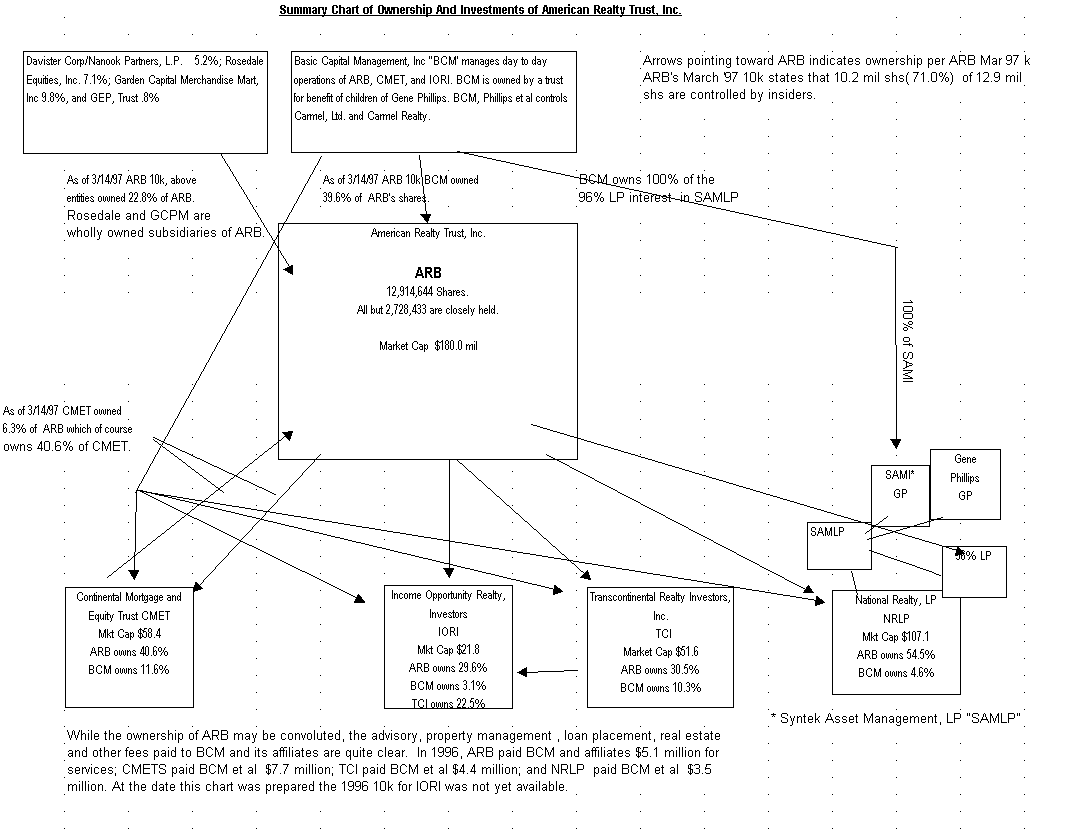
Well, we discovered that American Realty is, in fact, part of a typically Philippine intertwined nest of related entities. (Graphic) Take a look at the following (very simplified) chart of the cross-ownership between these five public companies. But do look quickly, because the SEC filings indicate that which Phillips entity owns how much of any other Phillips entity is subject to very drastic change from one day to the next.
When you start looking into each of these entities, you soon discover that what we are looking at is not one REIT, with a market cap on 1/1/92 of $16 mm, but a mini REIT conglomerate headed by a common management group. The combined market capitalization of the equity in these entities was valued at $529 million on 3/31/97. If you just rolled them up they’d have been valued 58th of our universe of 182 publicly traded real estate companies. As we shall see, however, each sells at a substantial discount to what management estimates to be the value of its underlying real estate assets. The focus of this report is on the Phillips controlled entities, and to simplify following these issuers, we will refer to the combined companies as "Son of Southmark" or "SOS" for short.
Who runs SOS (Son of Southmark)?
Understanding the interrelationship between these companies and the people involved is what makes an interesting story. First they have common officers, addresses and a common advisor. The advisor, and the address, is: Basic Capital Management, Inc. 10670 N Central Expressway Dallas, Texas 75231. The 10k notes:
"Basic Capital Management (BCM) Continental Mortgage & Equity REIT (CMET), National Realty LP (NOLP), and the Gene E. Phillips Trust (GEP Trust) may be deemed to constitute a "person" within the meaning of Section 13 (d) of the Securities Exchange Act of 1934, as amended, because BCM is beneficially owned by a trust established for the benefit of Gene E. Phillips' children and the executive officers of BCM are also executive officers of CMET. Gene E. Phillips is a general partner of Syntek Asset Management, L. P. ("SAMLP"), which is the general partner of NLP."
To understand how direct the control is look at this chart. Remember that in a Limited Partnership, as opposed to a corporation, the Limited Partner Investors have very few rights or controls on the General Partners. When you look through National Realty the control essentially resided with two entities, Gene Phillips, and the Gene E. Phillips Children’s Trust. That’s certainly not even slightly illegal, but as we try to explain what is pushing American Realty’s share price up (and what is holding National Realty’s unit price down) you have to understand that.
To follow that trail, Basic Capital Management ("BCM") is a private company organized in Nevada. Public documents say its "principal business activity is the provision of advisory services for real estate investment trusts." Its principal place of business and principal office is located at 10670 North Central Expressway, Suite 600 Dallas, Texas 75231. BCM is owned by Realty Advisors, Inc., a Nevada corporation. Realty Advisors, Inc. is owned by a trust established for the benefit of the children of Gene E. Phillips. The directors and executive officers of BCM are as follows:
Name, Position(s) with BCM
Randall M. Paulson, President
Oscar W. Cashwell, Executive Vice President
Thomas A. Holland, Executive Vice President and Chief Financial Officer
Clifford C. Towns, Jr., Executive Vice President, Finance
Bruce A. Endendyk, Executive Vice President
Cooper B. Stuart, Executive Vice President
Mark W. Branigan, Executive Vice President
Lynn W. Humphries, Senior Vice President, Commercial Asset Management
Dan S. Allred, Senior Vice President
Robert A. Waldman, Senior Vice President, General Counsel and Secretary
Drew D. Potera, Vice President, Treasurer and Securities Manager
Mickey Ned Phillips, Director
Ryan T. Phillips, Director
Remember those names because most of them reappear as officers of ART, CMET and TCI:
Name, Position(s) with ART, CMET, TCI
Randall M. Paulson, President
Thomas A. Holland, Executive Vice President and Chief Financial Officer
Bruce A. Endendyk, Executive Vice President
Lynn W. Humphries, Senior Vice President, Commercial Asset Management
Robert A. Waldman, Senior Vice President, Secretary and General Counsel
Drew D.. Potera, Treasurer
Ted P. Stokely, Trustee
Edward L. Tixier, Trustee
Martin L. White, Trustee
Edward G. Zampa, Trustee
A search of the 10Ks turned up five major areas not normally as prominent in most REIT SEC filings. Five extraordinary SOS issues stuck out:
1. FEES TO AFFILIATES
2. INSIDER TRADING
3. MARGIN ACCOUNTS
4. LEGAL ISSUES
5. "REVALUATION EQUITY"
To take them in order:
Extraordinary SOS Issue #1: FEES TO AFFILIATES
One of the trademarks of the limited partnership business of the 1980’s was the fee structure -- largely to the benefit of the General Partners. It appears that SOS has been able to transfer those fees into the REIT format. SOS almost seems to be an 80s limited partnership "Lazarus" come back in the form of a REIT. The combined management fees and cost reimbursements for the five companies in 1996 was $28.5 mm, or 5.4% of the combined market cap on 3/31/97. Together, with the dividends received from related companies, the total comes to $32,000,000 to run a group of assets that BCM publicly states is worth about $1.8 billion.
To compare these fees, we looked at the G&A expenses of diversified REITs of comparable size. WASHINGTON REIT <% if gsSubBrand = "aolsnapshot" then Response.Write("(NYSE: WRE)") else Response.Write("(NYSE: WRE)") end if %>, a $568 million diversified REIT, had G&A expenses of $3.095 mm, or 0.55% of market cap -- 1/10th the amount of SOS. To look at it another way, you could hire the management team running an equivalent size REIT (around $2 billion in assets) and pay its G&A of $9 million and still have $15 million a year left for increasing the dividend.
1996 |
ARB |
NLP |
CMET |
TCI |
IOT |
| Fees | $ 5,126 | $ 3,510 | $ 7,738 | $ 4,421 | $ 535 |
| Cost reimbursements | $ 691 | $ 825 | $ 1,047 | $ 140 | |
| Total | $ 5,817 | $ 3,510 | $ 8,563 | $ 5,468 | $ 675 |
| % of Mkt. Cap | 2.72% | 3.14% | 13.59% | 10.95% | 3.02% |
| TOTALS | $ 24,033 | ||||
| 5.21% | |||||
| 3/31/97 | |||||
| Price | 16.75 | 17.5 | 15 | 12.5 | 14.625 |
| Shares Outstanding | 12,765,082 | 6,387,270 | 4,199,147 | 3,994,687 | 1,530,008 |
| Market Cap | $213,815,124 | $111,777,225 | $62,987,205 | $49,933,588 | $22,376,367 |
| TOTAL MARKET CAP | $460,889,508 | ||||
| Shares Held by Affiliates | 8,855,644 | 3,720,894 | 2,163,447 | 1,726,454 | 839,552 |
| % of Total Shares | 69.37% | 58.25% | 51.52% | 43.22% | 54.87% |
| 1996 Dividends/share | $ 0.15 | $ 1.10 | $ 0.89 | $ 0.28 | $ 0.40 |
| Total Dividends | $ 1,914,762 | $ 7,025,997 | $ 3,737,241 | $ 1,118,512 | $ 612,003 |
| Affiliates Dividends | $ 1,328,347 | $ 4,092,983 | $ 1,925,468 | $ 483,407 | $ 335,821 |
| Dividends to Public Shareholders | $ 586,416 | $ 2,933,014 | $ 1,811,773 | $ 635,105 | $ 276,182 |
| Fees to Affiliates | $ 24,033,000 | ||||
| Dividends to Affiliates | $ 8,166,026 | ||||
| Total Cash Flow to Affiliates | $ 32,199,026 | ||||
| Cash Flow to Public | $ 6,242,490 |
However you slice it, the math is simple. Insiders at SOS cashed checks of $32,199,026 last year. The dear public shareholders got a whopping $6,242,490. Hardly seems worth paying for the stamps to mail those teeny dividends out, does it? SOS’s fees last year amounted to a very high (for REITs) 3.1% of market cap. Had they been 1% (almost double Washington REIT's) the SOS dividend would have been 7.3% and there might be a bit more lively public market for all these shares.
Extraordinary SOS Issue #2: INSIDER TRADING
As we have frequently mentioned on the Motley Fool Real Estate board, one of the desirable characteristics of a REIT is common interest of management and shareholders, as demonstrated by the ownership position of management. The higher the ownership position of management the better, or at least that’s what we usually think. In the instance of the SOS group, there can be no question of their position. Not only is their ownership position established, it grows on a monthly basis. Are management and minority shareholder interests in sync this time? Frankly we doubt it.
In the past, I have both executed the sale of "control" or "144" stock for officers of NYSE listed companies, and purchased stock for a Fortune 500 company in its "pre-filing" open market purchases of an acquisition target. Both situations require care in trade execution from both the account and the broker, since the trades are carefully scrutinized by the regulators. Both are subject to disciplinary action for "screw-ups".
My greatest involvement with the limitations of "insider trading issues" came shortly after the 1987 market crash. Numerous companies were announcing major stock repurchase programs both as a signal to the market that management felt their company prices were undervalued, and as a good use of company funds as stock prices traded below book value.
To garner some of this business, I proposed a new strategy -- the sale of "naked puts" for companies with listed options. The selling of put options offered these companies a unique opportunity to create value while fulfilling their repurchase commitments. Simply stated, as a seller of its put options, the company would undertake an obligation, for a certain period of time, to purchase shares of its stock at a set price known as the "strike’ price. In return for undertaking this obligation, the company receives a premium, in the form of cash, from the purchaser of the put. If the stock is below the strike price at expiration, the premium reduces the cost of the stock bought. If the stock is above the strike price, the option expires worthless, and the company keeps a tax advantaged cash flow.
Market volatility was so high at the time that the premium levels were at record levels, making the strategy even more appealing. Recently, the Wall Street Journal outlined how many companies today are generating billions of dollars using this strategy.
At the time, however, this untested approach needed SEC approval via a "no-action" letter from them indicating that the companies using this approach were not in violation of the Securities Exchange Act of 1934. Specifically the concern was with "Rule 10b-18".
"Rule 10b-18 under the Exchange Act(the "safe harbor" rule for open market repurchases by issuers) defines some of the activities that an issuer must not be entered into for the purpose of, or, to the extent possible, in a manner that results in, supporting or raising the prices of their stocks. In purchasing stock, an issuer should refrain from bidding for or buying such stock at prices above those established independently by others, buying on successive "upticks", dominating trading volume, trading at or near the close, and the like."
Neither I nor my associates are lawyers, but the section is quite specific, and it makes me wonder if the SOS purchases of their related entities stocks have not violated the spirit, if not the letter of the law. It is not very likely that they have been trying to drive the price up, but as we will see they for sure appear to have been dominating trading volume.
With these considerations in mind, we looked at a breakdown of the volume of the stock purchased for any given period of time to see what percent of the total volume the "SOS" buys represented. In 1987, I recall the limit on daily purchases was 25% of the last 30 days average volume. We’d leave it to others to judge that now, but here is a sampling of American Realty’s Purchases of National Realty:
| Fourth Quarter, 1996 purchases of National Realty LP by (ART) a subsidiary of American Realty (ARB) | |||||
| NLP Purchases Reporting Person | Date | Number of Units | Price Per Unit | Total Daily Volume | % of Total Volume |
| ART | 10/30/96 | 200 | $12.25 | 300 | 66.67% |
| ART | 10/31/96 | 200 | $12.25 | 300 | 66.67% |
| ART | 11/12/96 | 100 | $12.25 | 400 | 25.00% |
| ART | 11/13/96 | 200 | $12.25 | 200 | 100.00% |
| ART | 11/15/96 | 100 | $12.25 | 500 | 20.00% |
| ART | 11/19/96 | 800 | $12.25 | 900 | 88.89% |
| ART | 11/20/96 | 100 | $12.25 | 100 | 100.00% |
| ART | 11/21/96 | 100 | $12.25 | 2100 | 4.76% |
| ART | 11/26/96 | 400 | $12.25 | 2300 | 17.39% |
| ART | 11/27/96 | 2,200 | $12.25 | 3500 | 62.86% |
| ART | 11/29/96 | 100 | $12.25 | 100 | 100.00% |
| ART | 12/10/96 | 700 | $12.63 | 900 | 77.78% |
| ART | 12/11/96 | 1,700 | $12.63 | 3200 | 53.13% |
| ART | 12/23/96 | 200 | $12.75 | 400 | 50.00% |
| ART | 12/24/96 | 2,100 | $12.75 | 2100 | 100.00% |
| ART | 12/26/96 | 6,700 | $12.75 | 9500 | 70.53% |
| ART | 12/27/96 | 300 | $12.88 | ||
| ART | 12/27/96 | 600 | $13.00 | 900 | 100.00% |
| ART | 1/3/97 | 500 | $13.00 | 1400 | 35.71% |
| ART | 1/6/97 | 600 | $13.00 | 2300 | 26.09% |
| ART | 1/10/97 | 1,000 | $13.00 | 2400 | 41.67% |
| Totals | 18900 | 33800 | 55.92% | ||
Of even greater interest are the purchases of American Realty (ARB) by Basic Capital Management (BCM) in the first quarter of 1997 (graphic). Here the volume of stock American Realty bought was twice the reported volume of the shares traded, and the prices paid have no relationship to the high, low, or close of the stock on the day cited in the "13D." As these are stated on the 13Ds to be "open market" transactions, there is a requirement that the trades must be "printed" on an exchange. So why the wide differential? We do not know.
The persistence and increasing volume of this insider trading by SOS is illustrated in these charts. Please note that these charts, courtesy of Telescan, show the net number of insider purchases less sales, smoothed over twelve months - not the total shares bought.
The pattern seems to be that first insiders started to pick up shares in American Realty around 1991, about the time the Moorman settlement was agreed to. By the mid 90s, purchases of Transcontinental Realty (TCI), Income Opportunity Trust (IOTS) and Continental Mtg. (CMETS) were rapidly increasing and by 1995 insiders began to significantly increase their rate of buying NLP shares.
We wanted to look more closely at a period before the big run-up in American Realty’s share prices began. We picked the period from 10/31/96 to 1/10/97. Investor Insight reports that a total of 61,200 shares of American Realty traded in those 71 days. During that same period SOS entities’ SEC filings indicate they bought 18,900 of them. That represents a commanding 31% of all the shares traded.
Extraordinary SOS Issue #3: MARGIN BORROWING ON A REIT BALANCE SHEET?
Most real estate structures typically include a fair amount of leverage, and it comes in many forms; mortgages at the property level, sub-debt at the REIT level, secured, unsecured, lines of credit, etc. Never before, however, have we seen "margin accounts" on the balance sheet of any REIT we’ve looked at. It is, however, found throughout the filings of all the "SOS" entities. If nothing else, SOS is creative in its financing techniques. To quote American Realty’s 10K:
"Loans Payable. The Company has margin arrangements with various brokerage firms provide for borrowings up to 50% of the market value of marketable equity. The borrowings under such margin arrangements are secured by such securities and bear interest rates ranging from 7.0% to 11.0%. Margin were $40.0 million (approximately 34.5% of market value) at December 31 1996, compared to $34.0 million at December 31,1995. August 1996, the Company consolidated its existing National Realty, L.P.("NRLP") margin debt held by the various brokerage firms into a single loan of $20.3 million. The loan is secured by the Company's NRLP units with a market of at least 50% of the principal balance of the loan. As of December 31,1996, 3,418,319 NRLP units with a market value of $44.9 million were pledged as for such loan in August 1996, the Company obtained a $2.0 million loan from a financial secured by a pledge of equity securities of Continental Mortgage Equity Trust ("CMET"), Income Opportunity Realty Investors, Inc. ("IORI") Transcontinental Realty Investors, Inc. ("TCI") (collectively the "REITs" )by the Company and Common Stock of the Company owned by Basic Capital, Inc. ("BCM"), the Company's Advisor with a market value of $4.0. The Company received $2.0 million in net cash after the payment of costs associated with the loan. September 1996, the same lender made a second $2.0 million loan. The second is also secured by a pledge of equity securities of the owned by the Company and Common Stock of the Company owned by BCM with a value of $5.0 million. The Company received $2.0 million in net cash the he payment of closing costs associated with the loan."
As an institutional broker, my personal experience with margin practices and requirements has been somewhat limited. Margin accounts are typically the realm of the individual retail account. They are regulated by the U.S. Treasury and in essence are short-term loans extended by brokerage firms to enable their clients to put up only a portion (currently a maximum of 50%) of the value of stocks purchased. The margin agreement has detailed contractual elements. Stocks in these accounts are held in "street name" meaning that they are registered in the name of the brokerage firm that has ultimate control of the stock
I have on occasion arranged for a major client to use control stock as security for a margin loan. The results were an interest rate 300 basis points lower than what Chase Manhattan would lend the same client on a major business loan. While this was 20 years ago, and I don’t recall all of the restrictions on the use of "control stock" as collateral, it was considerable. This is because if the stock were to drop in value, the brokerage firm would be limited in selling the stock without a registration statement.
Because these loans are highly liquid, with control of the security in the hands of the lender, the rate is very low, typically 100 basis points below prime. The rate is negotiable, and typically inversely related to the amount borrowed. One Boston based discount broker advertises margin rates as low as 1% below broker call. Today that would be 6.25% vs. Prime @ 8.5%.
The first question that comes to mind is, why would they pay 400 basis points higher for some of their borrowings then they do for others (11% vs. 7%), The next question is, what is the purpose of holding margin accounts with 60, (yes, count them - 60) different brokerage firms? Conspicuously absent from this list is the largest brokerage firm of all, "Mother Merrill". This omission is especially interesting when you note that the background of the "Securities Manager" includes a stint at Merrill.
DREW D. POTERA: Age 37, Vice President (since December 1996), Treasurer (since August 1991) and Assistant Treasurer (December 1990 to August 1991). Vice President (since December 1996) and Treasurer (since December 1990) of CMET, IORI and TCI; Treasurer (December 1990 to February 1994) of NIRT and VPT; Vice President, Treasurer and Securities Manager (since July 1990) of BCM; Vice President and Treasurer (since February 1992) of SAMI; and Financial Consultant with Merrill Lynch, Pierce, Fenner & Smith, Incorporated (June 1985 to June 1990).
Given his evident qualifications, some questions come to mind for Mr. Potera, such as "Having lived through October 1987 as a broker, do you remember the days, when your accounts could not reach you because Merrill’s phones were constantly busy?
For answers to some of our questions, I turned to an old friend, Phil McMorrow, who is currently the Chief Compliance Officer of a regional NYSE member firm. Though a former regulator with the National Association of Securities Dealers (NASD), Phil said this was new to him, too, and it would raise a number of red flags if these accounts were under his supervision. First, all of the margined stock would be considered "control" stock and have limited collateral value in a margin account by itself. He was also at a loss to explain how the companies could account for "Open Market" purchases of this control stock at prices other than were printed on the tape.
Again more questions with few satisfactory answers.
The next table lists all the brokerage firms margining these securities in the latest filings with the SEC and their risk exposure to a sudden drop in the prices of these five inter-related stocks. We have no way to know whether any of them has considered the effects of the effective cross collateralization of their holdings.
"Sixty, Count ‘em, Sixty" |
|
| Broker/Dealers |
Total Exposure on Margin |
| Advest, Inc. | 99,225 | Legg Mason (TX) | 42,500 | ||
| The Advisors Group | 26,400 | Marsh Block | 19,050 | ||
| Alex Brown (NY) | 485,450 | May Financial | 90,700 | ||
| Allied | 22,050 | McDonald & Co | 92,600 | ||
| American Express Fin. | 40,900 | Montgomery | 37,900 | ||
| Arnold Sec. | 43,400 | Morgan Keegan | 70,356 | ||
| Baker & Co | 33,982 | Mutual Sec. | 289,975 | ||
| Baraban Securities | 17,000 | NationsBanc Cap | 158,109 | ||
| Boatmen's | 45,850 | Nationwide Sec. | 63,450 | ||
| Brown & Co | 365,436 | Neuberger | 16,500 | ||
| Bear Stearns | 129,550 | Olde | 95,350 | ||
| Bidwell & Co | 29,500 | Oppenheimer (NY) | 203,192 | ||
| Chase Securities | 27,200 | Oppenheimer (TX) | 66,837 | ||
| Chatfield Dean | 55,075 | Pacific Brokerage | 69,400 | ||
| CJ Lawrence | 61,500 | The Principal Group | 145,684 | ||
| CS First Boston. | 3,639,810 | Prudential (TX) | 120,400 | ||
| Cowen & Co. | 38,750 | Raymond James | 191,200 | ||
| Dain Bosworth | 302,487 | Rauscher Pierce Refsnes | 186,000 | ||
| Dean Witter (NY) | 681,125 | Regions Inv. | 9,500 | ||
| Dean Witter (CA) | 48,500 | Rodman & Renshaw | 49,150 | ||
| Equitable | 45,700 | Roney & Co | 52,374 | ||
| First Southwest | 123,700 | Securities of America | 41,750 | ||
| Global Strategies | 118,548 | Signet | 10,250 | ||
| Goldman Sachs | 99,480 | Southwest Securities | 8,200 | ||
| Hambrecht & Quist | 54,550 | Tucker Anthony | 381,791 | ||
| HD Vest | 10,500 | United Pacific Bank | 49,350 | ||
| Interfirst Capital Corp | 19,000 | UBS Securities | 26,500 | ||
| JB Oxford | 25,500 | Wachovia | 28,700 | ||
| Jefferies (TX) | 32,500 | Washington Discount | 175,218 | ||
| JW Charles | 48,000 | Wedbush Morgan | 42,250 | ||
| Source: Company Filings with the SEC | TOTALS |
9,604,904 | |||
(We have a spreadsheet available that provides greater detail for any broker/dealers that may have an interest in the interrelationship of their individual positions. If any of the firms would like a copy, please e-mail [email protected] or post a request on The Motley Fool Real Estate message board. We’d be pleased to e-mail it out promptly.)
The use of margin in this fashion raises a number of other questions. If one man and his family trust represent most of the demand for these stocks, are the lenders against these shares truly secured by liquid assets? How deep is the market when so much of the demand is in the hands of so few people, all interrelated and all with debt against their positions?
Extraordinary SOS Issue #4: "REVALUATION EQUITY"
We have never before run across the term "Revaluation Equity." The 10K of National Realty and American Realty’s holding positions in National Realty are quite clear in its definition.
"In conjunction with the exchange transaction, by which the Partnership was formed, the Partnership retained independent appraisers to estimate the Current Appraised Value of the Partnership's properties as of March 31, 1987, based in part upon certain financial, lease and other information provided by the general partners of the exchange transaction partnerships. The Current Appraised Value of the Partnership's properties at March 31, 1997 was $758.0 million, and Revaluation Equity was $410.0 million at such date. Revaluation Equity is defined as the difference between the appraised value of the Partnership's real estate, adjusted to reflect the Partnership's estimate of disposition costs, and the face amount of the mortgage notes payable and accrued interest, if any, encumbering such real estate. The Current Appraised Value of the Partnership's properties at December 31, 1995, was $654.1 million, and Revaluation Equity was $310.0 million at such date.
In 1996, the Partnership retained an independent appraiser to determine the Current Appraised Value of the Partnership's properties as of December 31, 1996, in a manner consistent with the methodology used to determine Current Appraised Value as of December 31, 1995 and March 31, 1987. The Current Appraised Value of the Partnership's properties at December 31, 1996 was $691.5 million and Revaluation Equity was $345.9 million at such date."
This Revaluation Equity is at the heart of this curious assembly of real estate interests. We regret that it took us so long to take you through this maze to get here, but this is the Rosetta Stone for unlocking the value in American Realty and the rest of the SOS entities. The potential to transfer that "Revaluation Equity" away from the partners of National Realty and hand it to the stockholders of American Realty at a great discount is the hidden engine that appears to be driving the increase in the shares of American Realty, and the anger and the attorneys of the non-insiders at National Realty.
The legalese simply means that in 1987 the General Partners claimed the underlying assets of National Realty were worth $410,000,000 more than the value of National Realty’s shares and at that time they owned 9% of the whole pie. Today they tell us the assets exceed the value of the stock by $345,900,000 and the General Partners own about 60% of the pie. If you divide $410,000,000 by the approximately 12.9 million shares outstanding today, you will see the General Partners wanted someone to believe there was $31.78 per share in excess value in 1987. Since the Revaluation Equity has declined a bit, they want someone to believe that Revaluation Equity is worth $26.81 per share today, and they acquired 51% of the outstanding shares or about 6,579,000 shares while the judge has been sitting on this case. Those shares have concealed in them Revaluation Equity of about $176,000,000. We weren’t able to find an exact figure for their cost of acquiring those shares but it’s clearly well below $4 per share.
This rough (but probably pretty close) math leads to an astonishing conclusion. While acting as a fiduciary and a General Partner, and while operating directly under the scrutiny of Judge Jenkins, SOS has been able to acquire something like $176,000,000 in real value from its helpless Limited Partners and it has probably cost SOS well under $26,300,000 to do it.
While acting as a fiduciary and a General Partner, SOS has been able to pay itself generous fees which were available to help in those purchases, and its affiliates have co-operated by margining the stocks and even paying the interest on the margin loans. It’s a wonderful country, but not every part seems to work quite as intended, and the California court system seems to be in need of some work under the hood.
The combined publicly traded market cap of the SOS entities on 3/31/97 was $529 mm., and National Realty was valued at $100 mm. If we subtract $100 million from the total, and substitute the $410 million that management’s appraisers say it is worth, we come up with a total value of $839 mm. That would rank SOS 37th out of our universe of 182 Equity REITs. That is a pretty dramatic increase, but if National Realty is trading at 25 % of its appraised value, could it be that the four SOS REITs are trading at similar discounts to the value of their underlying assets?
Why not? As SOS has siphoned off earnings, FFO, and dividends, from "the little guy" investors, diverting these cash flows into the margined purchases of each other’s stock, we could be looking at appraised real estate of over $2 billion. In fact, a promotional brochure sent out by BCN values the SOS public entities’ assets at over $1.8 billion.
The particular nature of this relationship is a kind of incestuous circularity. The engine driving the growth in American Realty's value appears to be its ability to buy National Realty's shares at a huge discount from the value of it underlying real estate. Between the $32 million in cash flow the SOS principals now control and their ability to borrow on margin, they can effectively buy as much of these stocks as they like, when they like. Sooner or later the holders of National Realty, and possibly the other REITs as well, will tire of receiving measly dividends from a management that Wall Street analysts are never going to love anyway. As the number of shares available to be bought dwindles, the discount from private market values real estate should also narrow, but remember that the value of the shares sitting in those 60 margin accounts will simultaneously rise.
The interest rate paid on the margin accounts is not terribly critical to SOS. After all it reduces the FFO available to pay dividends. That in turn helps keep the market price of the public’s shares down to a level where the assets can still be bought cheaply. Once the SOS folk have acquired all the shares they want, they can always start paying down the margin debt with some of their cash -- or Basic Capital Management could conceivably first buy more shares in the REITs, thus doing to American Realty the same thing American Realty has been doing to National Realty.
One can wonder, too whether there is a similar motivation in why about 25% of American Realty's assets seem to have become invested in some very desirable, but non-income producing raw land. That too is an asset that does not produce the FFO that the Wall Street analysts are seeking, but it is a great thing to borrow against and a great place to store hidden value where most REIT analysts won’t see it. A desire to avoid Wall Street analysts’ scrutiny may help explain another curious question. Why did American Realty split its stock when the price got around $11 a share? To encourage small investors? Or to stay close to being a "penny stock" the institutions won’t consider?
In answer to the question that the editor of The Fool’s Daily Double asked us long ago, as long as Judge Jenkins permits American Realty to buy the partnership interests of the Limited Partners of National Realty at a huge discount from private market real estate values, American Realty can enrich itself. If the price of the shares gently rises, American Realty and the SOS team can continually margin more against what they own. To the extent that they want to invest hard equity dollars in addition to their margin lines, they have $32,199,026 coming in annually with which to do it.
Once upon a time the National Realty limited partners had warrants to buy more shares and that might have put the value of American Realty’s shares at risk to dilution. As a part of the Moorman Agreement, they had the right to expand their ownership of NLB by about 30%. Oh, did we forget to tell you when the options expired? They had never become "in the money" between the effective date of the Moorman Agreement on May 9, 1990, and when they expired on Feb. 14 of this year. Ironically, we’d guess that the fact that American Realty's stake in National Realty could no longer be diluted by the warrants may have been one of the major factors that then drove American Realty’s stock price through the roof in March.
Extraordinary SOS Issue #5: LEGAL ISSUES -- Litigation, Roll-ups and The Moorman Agreement.
Litigation has been pending over National Realty for over decade and some first rate lawyers have been employed by both sides. National Realty first traded shares on October 8, 1987, a few days before the great Black Monday crash. The class action litigation which became "Moorman et. al." had already been filed , based on the offering prospectus, a month earlier on September 2. Whether the roll-up of the Limited Partners’ interests should have been allowed is open to debate but the first day’s trading was disastrous. NLP closed down 40% from the claimed "market value" Southmark had put on its the underlying assets.
The lawyers suited up for battle, the judge pressed for settlement but with so much at stake, and so much in assets to play with, the settlement leading to the Moorman Agreement wasn’t announced until May 9, 1990. As simply as we can describe it, the Limited Partners had alleged that they would have been better off if the properties owned by the individual Southmark partnerships had been sold in 1990 than they would by merging their private limited partnership shares for interests in new the publicly-traded vehicle controlled by Mr. Phillips’ and his Syntek
Judge Jenkins is known for preferring to preside over settled complex business cases rather than over litigation in his court. Perhaps in part as a result of that predilection, a 115-page document known as the "Moorman Settlement Agreement" was agreed to on May 9, 1990. The parties were the class including the Limited Partners of National Realty on the one hand, and Southmark Corporation, Gene Phillips, National Realty, its Operating Partnership, Shearson, Lehman Hutton and the rest of the related entities and John Does on the other. Whether the settlement agreement Judge Jenkins had encouraged was a good deal for the Limited Partners or not may be open to question, but the financial markets hated it. The Street had a one-word answer to the old song "Will You Love Me in December as You Did in May?" The word was "No."
Units went from $4.50 when the agreement was announced in May down to below $2.00 by New Year’s Eve. As the charts we saw earlier demonstrate, it was just about 1991 that a pattern of Phillips entities purchasing National Realty’s and one another’s shares began which have continued to this day.
James Fotenos Esq., the Class Counsel, wrote in a recent filing that the essence of the agreement was "to establish mechanisms designed to enable the members of the Moorman class to realize, in distributions and in share price increases, the equity value of the real properties of National Realty."
The heart of the deal was that if National Realty’s management could not get value for its Limited Partners then management would get out of the way and let someone else try. If management did get bounced, there was also a formula to buy them out. You don’t have to take our word for it, though. American Realty’s 10K for 1996 contains a 1,988 word, four-page footnote describing the litigation.
So far so good. The Moorman Agreement said that excess fees to the GPs should stop, or at least be held in abeyance. The affairs of the partnership should be supervised by an oversight committee that contained a majority of third party folk. The GPs should be incentivized to meet some real operating performance targets or be removed.
If the real estate recovery of these primarily sun-belt properties was rapid then the LPs could exercise a big bunch of warrants and recapture a major piece of the upside they believed had been taken away from them by the roll-up. If things went badly at the property level, a simple majority of the LPs would be sufficient to throw the GPs out. Meanwhile there was an auditor and a supervising committee to ensure that none of the cash flow got diverted. We all know that Texas real estate has undergone a spectacular recovery since 1990. The legal belts and suspenders were firmly in place. What could go wrong?
Well, first of all, the performance targets were never met so for two years National Realty’s stock languished. Why did the stock languish? Well by 1992 the Street was thoroughly disenchanted with Limited Partnerships, and just beginning to awaken to its new love affair with REITs. Even today, the Street today generally values REITs at more than private market values and real estate limited partnerships at less. It’s probably also true that there’s not a whole lot of faith in Mr. Phillips around among investment bankers now that Drexel’s gone. The main problem appears to have been that the best interests of the Limited Partners would have been served by selling these assets to some REIT whose structure and management was not tainted. As long as the Philips entities controlled only 9% or even 18% of the units, the great bulk of that extra value would flow to pockets not related to Mr. Phillips, his family trust, or any principals of SOS.
So as the stock price languished after 1990, several of the Phillips entities started to remedy that leakage. They began acquiring the shares of National Realty. From a 9% position at the outset, they had grown to an 18% position when the settlement was filed. Then, as we have seen in the graphs above, Phillips entities have consistently acquired the shares of despairing Limited Partners. The 13Ds and the reports of trading volume on the exchanges indicate that they were often buying in something like 30% of all the shares offered. While never using their buying power to drive the stock into a price where the warrants were in the money, they now control over 50% of NLP. At this point the clause allowing of 50% of the shareholders to throw out the General Partner -- or to approve any other action -- stops being a protection for the outside investors and becomes a hunting license for the insiders.
In any event, management had been required to resign as General Partner of National Realty as a result of lack of performance, but the Moorman Agreement called for the appointment of a replacement General Partner and an "exit fee" as compensation to the outgoing General Partner.
In a complaint dated May 29 of this year, the counsel for the Limited Partners’ class action noted that the warrants had never in the money. Then on February 14, 1997, just about the time American Realty’s stock took off like a scalded jackrabbit, the warrants -- and the chance that American Realty's stock in National Realty would be diluted --disappeared into thin air. As the American Realty 10K notes:
The Targets for the first and second anniversary dates were not met. Since the Targets were not met for two successive years, the Moorman Settlement Agreement requires that SAMLP resign as General Partner, effective upon the election and qualification of its successor. On July 8, 1992, SAMLP notified the Oversight Committee of the failure to meet the Target for two successive years.
Withdrawal of SAMLP as General Partner pursuant to the Moorman Settlement Agreement requires unitholders to elect a successor general partner by majority vote.
So here you might think we’ve reached the end. SOS misses their targets, the Generals are removed by the Limiteds, and finally the assets are to be sold -- but no -- in fact that doesn’t happen. By the time the removal takes place, Robert McNeil has resigned from the oversight committee. That leaves two "independent" members. One is Ronald Baker who had bought a number of units on the secondary market for clients, and the other is a Kenneth Kelley. Mr. Baker complains in a letter to the judge that an associate of Mr. Kelley ends up doing a fair amount of consulting for the committee with the consent of Mr. Phillips at a fee -- in the substantial neighborhood of $250,000. Baker alleges that the work promised is never performed, and things generally get unpleasant. For whatever reason the dispute boils up between Mr. Kelley and Mr. Baker and they are unable to agree on a successor for Mr. McNeil. By July of 1992 Mr. Kelley notifies Judge Jenkins that he and Baker can not agree on a replacement for McNeil and the oversight committee is effectively deadlocked from performing its mission. At that point Baker gives in in order to avoid a Syntek-chosen replacement and Kelley’s choice is selected.
Now the time has finally come to wind up the Moorman agreement and have a New General Partner sell the properties. The hearing this Friday is on an "Implementation Agreement" for that wind-up. If the class action committee’s lawyer is to be believed, the net result from Syntek’s proposal will be a difference without a distinction. The new proposed General Partner is a Mr. Elliott. Attorney Fotenos alleges that this is no real difference for several reasons. One of them is that after 36 months Mr. Phillips and his associates will have the right to remove Mr. Elliott and come back in as General Partners.
Another is that the new General Partner Organization (GNRP) discloses that it "has agreed to use the asset management, property management, and brokerage services of Mr. Phillips affiliates in the management of National Realty unless Mr. Elliott concludes that another party can perform such services as well and upon more advantageous terms to National Realty."
There will be some differences if the implementation agreement goes through. It will give Syntek an "exit" fee of some $12,500,000. The SOS group seems to suggest that may almost be in the nature of a charitable gesture. Their proposed solicitation states there would have been a much larger fee due if they hadn’t compromised. Still, it does seem to us that if SOS is going to get a $12 million exit fee they should really exit, not just pop outside for a quick smoke.
The proposed deal is bizarre at best. Syntek gets a $12 million fee to leave, but not really leave, and certainly not leave for long. Truth to tell, though, it’s hardly the most Byzantine aspect of the entire transaction. For example, SouthPoint magazine reports that some years ago Mr. Phillips’ erstwhile partner William Friedman was Southmark’s Vice Chairman and helped mastermind a $3 a unit Southmark tender offer for National Realty. Then, in his other role as one of National Realty’s GPs, the very same Mr. Friedman recommended that the Limited Partners not sell to Southmark because the price was too low. We had thought we’d seen it all by now, but reading that boggled our minds.
CONCLUSION:
Most of our analyses of a stock end in a conclusion of value -- buy, sell, or hold. As our title suggests, though, we can’t opine here because what is at issue is not susceptible to business analysis. The key to determining value for American Realty is deciding what will happen to the ‘Revaluation Equity" entrapped in the shares of National Realty. The General Partners’ of National Realty publish statements that enable one to estimate the value is $60 a share. That may be the right value, or it may not, but who gets to benefit from that value will be a legal issue, not one of appraising bricks and sticks. At the time of that estimate, ARB was trading at around $6.50 and even today is closer to $12. If some regulator or jurist decides there is a material problem with the manner and concentration of the inside dealings, you can imagine almost any price for any of these securities. We would underline in that regard that the hard-nosed Mr. Phillips has so far been brilliantly advised by counsel. It would be hard to believe they have slipped up on an issue as basic as that one, though we would ourselves be perplexed to explain how they might not have.
So it will be a legal determination and we have no more expertise than anyone else at predicting the outcome of long California trials. It is hard not to feel compassion for the Limited Partners whose fates were run through the ringer in Judge Jenkins’ courtroom. It is pretty clear from this and other cases that Limited Partners ought not to take too much comfort from any fiduciary obligation they may believe that GPs owe them. The courts don’t seem to be putting many teeth in that concept. Finally, if there has been a conscious effort to keep the price of these securities in a range it was probably to keep them from zooming too high. The SEC doesn’t have a lot of rules about depressing the price of your own stock, so if the judge makes a decision in the Limited Partners’ favor we’d bet it gets appealed. Nonetheless, we thank the editor of The Fool’s Daily Double for asking us why American Realty's stock was behaving so strangely. It has been a fascinating experience to try to find him an answer.
Respectfully,
MF Foitdog with TMF Yorick and WGCAMP
End notes:
1) For those of you who have become SOS junkies in the course of this long piece we offer a more detailed and complex chart and a perplexing table prepared by William Campbell at ERC. The chart is a more detailed explanation of the cross-ownership of the various SOS entities as of the end of the first quarter of 1997. In case that gives you false comfort as to the ease of understanding this transaction, the table shows how the various SEC filings indicate that reported ownership stakes of American Realty in various Son of Southmark entities changed between four different days over four months.
2) If you are really a glutton, you may want to browse the net until you find American Realty’s SEC filing. The particular section is entitled: "NOTE 13. COMMITMENTS AND CONTINGENCIES Moorman Settlement Agreement"
For the less hardy among you, excerpts from that accounting footnote follow:
The Moorman Settlement Agreement provides for a plan (the "Moorman Settlement Plan") consisting of, among other things, the following:
(i) the appointment and operation of a committee (the "Oversight Committee"), to oversee the implementation of the Moorman Settlement Plan,
(ii) the appointment and operation of an audit committee having a majority of members unaffiliated with Messrs. Phillips and Friedman or SAMLP,
(iii) the establishment of specified annually increasing targets described below (each a "Target") for each of the next five years through May 1995, relating to the price of the units of limited partner interest as decreased for certain distributions to unitholders,
(iv) an agreement by SAMLP not to seek reimbursement of greater than $500,000 per year for Messrs. Phillips’ and Friedman’s salaries for serving as general partners of SAMLP, (Mr. Friedman resigned as general partner of SAMLP effective March 4, 1994) and a deferral of such payments until such time as a Target may be met, and, if SAMLP resigns as General Partner, a waiver of any compensation so deferred,
(v) a deferral until such time as a Target may be met of certain future annual General Partner compensation payable, pursuant to the Partnership’s governing documents, to SAMLP or its affiliates, and, if SAMLP resigns as General Partner, a waiver of any compensation so deferred,
(vi) the required distribution to unitholders of all the Partnership’s operating cash flow in excess of certain renovation costs, unless the Oversight Committee approves alternative uses for such operating cash flow,
(vii) the issuance of Warrants to purchase an aggregate of up to 2,019,579 units (the Warrants) to Class Members,
(viii) the contribution by certain co-defendants of cash and notes payable to the Partnership aggregating $5.5 million (including $2.5 million to be contributed by SAMLP and its general partners over a four-year period),
(ix) the amendment of the Partnership Agreement to reduce the vote required to remove the General Partner from a two-thirds vote to a majority vote of the units,
(x) the Partnership’s redemption of its unit purchase rights and an agreement not to adopt a similar rights plan without Oversight Committee approval and
(xi) the Partnership’s payment of certain settlement costs, including plaintiffs’ attorneys’ fees in the amount of $3.4 million. The Moorman Settlement Plan will remain in effect until SAMLP has resigned as General Partner and a successor general partner is elected and takes office, and the Warrants remained exercisable for five years from the date of issuance and expired on February 14, 1997.
DISCLOSURE: Jerome Scott, Michael Dowd and WGCAMP all note that they have not and do not own or ever have taken long or short positions in any of these securities.
| Shares Change Hands Frequently in SOS entities, But Why? If we could figure it out, we’d tell you. One thing we know, though, the very intelligent Mr. Phillips has a reason. | |||||
Ownership of ARB |
|||||
| 13d Filings Dated | 1/10/97 | 1/9/97 | 10/17/96 | 10/16/96 | |
| ART | 450,202 | 1,193,767 | 447,902 | ||
| BCM | 47,850 | 380,212 | 2,540,330 | 31,450 | |
| TCI | 341,500 | 341,500 | |||
| SAMLP | 26,475 | ||||
| GEP Trust | 46,500 | 49,166 | |||
| CMET | 409,044 | ||||
| NOLP | 97,866 | ||||
| Total | 839,552 | 1,646,954 | 3,096,406 | 820,852 | |
| Market | Revaluation | ||||
| 100% of NRLP | $107.1 | $345.9 | |||
| Shs | 6.33 | 6.33 | |||
| Per Share | 16.92 | 54.64 | |||
| Insiders ($3.4 mil ARB) | 3.73 | ||||
| Others | 2.60 | ||||
| Total Shares | 6.33 | ||||
Michael Dowd ([email protected])
© Copyright 1995-2000, The Motley Fool. All rights reserved. This material is for personal use only. Republication and redissemination, including posting to news groups, is expressly prohibited without the prior written consent of The Motley Fool. The Motley Fool is a registered trademark and the "Fool" logo is a trademark of The Motley Fool, Inc. Contact Us